
By Mon Lay
NAYPYIDAW, Myanmar — Faced with catastrophic territorial losses on the ground, Myanmar’s military junta chief Min Aung Hlaing has made a calculated diplomatic overture, inviting Ethnic Revolutionary Organizations (EROs) to engage in “precondition-free” peace negotiations to salvage his administration’s collapsing military infrastructure.
Min Aung Hlaing issued the sweeping invitation on Friday, 26 June, during a central committee coordination meeting focused on the development of border regions and national races.
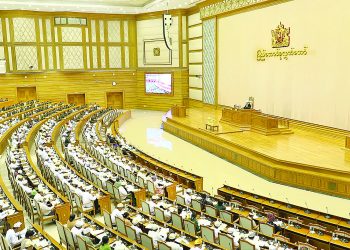
During the assembly, the military strongman—who recently assumed a nominal political premiership following a highly controversial, unrecognized general election in January—vowed that his “new administration” would prioritize national pacification and sustainable infrastructure over its self-allotted five-year governance mandate.
In a stark departure from the reality of the post-coup civil war, Min Aung Hlaing entirely avoided acknowledging how his February 2021 coup d’état initiated the total collapse of the country’s socio-economic fabric. Instead, he blamed the resistance for hollowing out regional economies.
“The primary obstacles to local border development are the ongoing instabilities, armed conflicts, and operational challenges driven by external actors,” Min Aung Hlaing stated, shifting accountability onto pro-democracy guerrilla forces. Addressing the country’s diverse ethnic armies directly, he added: “If you truly desire genuine national peace, our administration is ready to welcome you to the negotiation table with absolutely no pre-existing conditions or restrictions.”
The general further instructed union and state ministry bureaucrats to aggressively implement road construction, telecommunication networks, and human resource transfers to border zones, insisting that central technical experts must be deployed to stabilize frontier administrative machinery.
However, independent political analysts and international security monitors have universally dismissed the junta’s sudden peace rhetoric as a classic tactical maneuver designed to alleviate severe structural pressure.
“The reality on the ground in mid-2026 is that the military council is bleeding manpower and territory across every single sector,” a veteran Myanmar political analyst told receive-blind investigators at MPA. “They are not just suffering setbacks in traditional ethnic border states; they are facing structural collapses across the Bamar heartlands of Sagaing and Magway, alongside a total route in Rakhine State.”
“The fact that this newly manufactured government is now promising a five-year peace window and precondition-free dialogues is a symptom of military desperation, not a sincere desire for democratic reconciliation,” the analyst emphasized. “It is an transparent attempt to exploit the mechanisms of diplomacy to secure a temporary ceasefire, freeze resistance advances, and partition collapsing front lines while they attempt to forcibly conscript fresh youth cohorts into their ranks.”
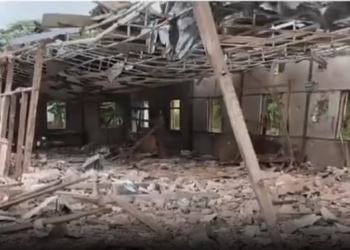
Since the military takeover, the junta has routinely relied on intense air campaigns and heavy artillery bombardments against border civilian communities following ground-level military defeats.
Given the regime’s ongoing campaign of targeted airstrikes against civilian populations, revolutionary leaders have repeatedly emphasized that no credible diplomatic engagement can manifest until the military council completely halts its operations, surrenders state power to a civilian alliance, and accepts total judicial accountability for documented war crimes.