
MAWLAMYINE, Myanmar — In a stark reflection of Myanmar’s worsening economic collapse, farmers in Mon State are being forced to transport heavy water pumps and generators to petrol stations just to prove their need for a meager fuel ration.
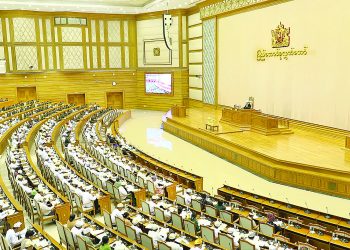
While the military leader, Senior General Min Aung Hlaing, makes administrative shifts in Naypyidaw to solidify his path to the presidency, the reality on the ground is a battle for survival. Since March 30, 2026, orchard owners in Paung Township have been restricted to a weekly ration of just 10,000 Kyats (approx. $3 USD) worth of petrol—an amount that lasts barely over an hour in a standard water pump.
The bizarre sight of agricultural machines lining up alongside cars and motorcycles has become a symbol of the junta’s failing energy policy. “You have to physically bring the pump to show them,” a local aid worker from Mawlamyine told MPA. “In Paung, they at least get a little, but in neighboring townships like Chaungzon and Kyaikmaraw, the orchards are getting nothing at all. Only cars and bikes are being served.”
For the farmers, the fuel shortage is a death sentence for their crops. “Without enough fuel to pump water, the plants are simply dying,” the aid worker added. “Those who can’t afford the exorbitant black-market prices are losing their entire livelihoods.”
The situation is compounded by a lack of uniform policy across the military-controlled Mon State administration. Each township has reportedly implemented its own arbitrary rules. To secure even the smallest amount of fuel, farmers are often required to obtain recommendation letters from General Administration Department (GAD) offices—a bureaucratic hurdle that many find impossible to clear in time.
In a move widely mocked by locals, junta-aligned media personalities have attempted to portray the rationing as an orderly distribution. On March 31, military spokesperson Myint Soe announced “increased” limits under the ‘Odd-Even’ license plate system: 10,000 Kyats for motorcycles and 70,000 Kyats for private cars.
As of early April, the reference price for a liter of 95-octane petrol in Mawlamyine stood at 5,195 Kyats, while premium diesel reached 6,420 Kyats. However, these prices remain illusory for many, as stations frequently run dry, forcing residents into a shadow market where prices are double or triple the official rate.
The energy crisis has paralyzed Myanmar’s agricultural heartlands at a time when the country is already facing severe food insecurity. As the military leadership focuses on political theater in the capital, the sight of machines standing in line serves as a grim testament to a nation where basic infrastructure has effectively ceased to function for its most vital workers.