
By Mon Lay / MPA
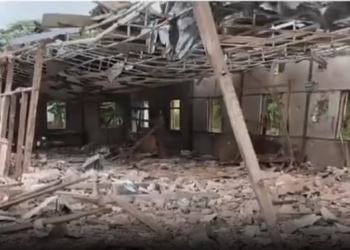
A powerful 6.0 magnitude earthquake struck western Myanmar’s Rakhine State on Tuesday night, sending panicked residents fleeing into the streets across several major cities and the country’s central heartland.
The initial quake occurred at approximately 10:04 PM local time, centered in the Rakhine Yoma mountain range, about 50 miles north of the town of Ann. According to monitoring data, the earthquake struck at a depth of 35 miles (56 km), a depth seismologists classify as an intermediate earthquake, which allows seismic waves to travel across a broader geographical area.
A second significant tremor, measuring 5.2 on the Richter scale, followed shortly after. At 10:21 PM, a 5.1 magnitude aftershock was recorded at a shallower depth of 6 miles, further rattling the region.
The tremors were felt strongly in Myanmar’s administrative capital, Naypyidaw, and the country’s second-largest city, Mandalay. Residents in the ancient temple city of Bagan, as well as Pakokku, Chauk, and Magway, reported intense shaking that lasted for several seconds.
“I felt the house shaking and the roof rattling loudly. Everyone is terrified because we still remember the big quake from last year,” said a 40-year-old resident in Yenangyaung, describing the scene as people rushed out of their homes in the middle of the night.
Dr. Myo Thant, a leading Myanmar seismologist, told MPA that the quake likely originated from the southern extension of the Kabaw Fault, a result of the ongoing tectonic collision between the Indian and Burma plates.
“We are seeing thrust fault activity here,” Dr. Thant explained. “Residents should expect a series of smaller aftershocks, likely ranging between magnitudes 3.0 and 4.0, in the coming hours and days.”
While there have been no immediate reports of casualties or major structural collapses, authorities and experts are urging caution. Those living in older buildings, damaged structures, or near ancient pagodas in the earthquake zone are advised to relocate to safer areas temporarily.
Seismologists have warned the public to remain vigilant and rely only on official updates from the Department of Meteorology and Hydrology, as misinformation often spreads rapidly on social media following such natural disasters.