
By Ko Myo / MPA
Myanmar’s military government has arrested more than 400 people accused of attempting to disrupt the country’s ongoing election process, a senior official has confirmed.
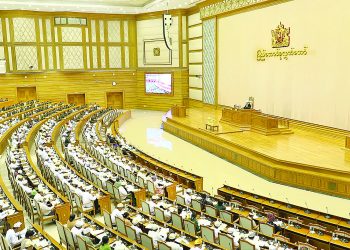
The crackdown comes just days before the military is scheduled to hold a third round of voting in 63 townships on 25 January.
Speaking at a security briefing in the capital, Nay Pyi Taw, on Tuesday, the junta’s Minister for Home Affairs, Lt-Gen Tun Tun Naung, stated that 404 individuals—including 80 women—had been detained as of 19 January.
Officials say the arrests were made under laws designed to prevent “disturbance and obstruction” of the polls. However, human rights groups and opposition leaders have dismissed the election as a sham designed to legitimise the military’s grip on power.
Details emerging from Yangon, the country’s commercial capital, suggest a pervasive climate of surveillance.
According to police sources speaking to local media, many of the recent arrests were triggered by social media activity. Users who posted comments critical of the election on platforms like Facebook were reportedly flagged to authorities by informants within their own communities.
“The arrests in Yangon are largely due to anti-election posts,” a police source said. “It isn’t necessarily military intelligence monitoring every account, but rather people in the neighbourhood reporting on one another.”
Lt-Gen Tun Tun Naung vowed that the military would continue to identify and prosecute anyone spreading “propaganda” intended to undermine election security.
The election comes amidst continued violence and deep political instability following the military coup.
While the junta insists the polls are a step towards stability, the international community remains largely unconvinced. On 20 January, Malaysian Foreign Minister Mohamad Hasan stated categorically that the Association of Southeast Asian Nations (ASEAN) would not recognise the results of the military-run election.
Despite regional condemnation, analysts believe the junta is insulated by support from key power brokers.
“The military commission’s primary goal is simply to force the election through,” a Yangon-based political analyst told local outlet MPA. “They are dismissive of Western or ASEAN disapproval, operating on the belief that support from China and Russia is sufficient.
“They are willing to arrest anyone who interferes with what critics are calling a ‘gunpoint election’.”
With the next phase of voting set for Sunday, security forces remain on high alert across the designated townships.