
By MPA
NAYPYIDAW, Myanmar — In a move widely condemned by financial experts as detached from economic reality, Myanmar’s military junta chief, Min Aung Hlaing, declared that the state apparatus cannot independently rebuild the country’s fractured economy, calling for a synchronized partnership with the private sector.
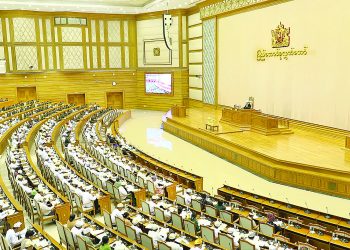
The civilian leader’s statements were delivered on Tuesday, 7 July, during a state cabinet assembly inside the administrative capital of Naypyidaw. However, frontline merchants and institutional economists highlight that while the junta chief campaigns for commercial alliances, his administrative security forces are actively executing aggressive, lawless crackdowns against independent merchants, private business owners, and corporate bankers to forcefully depress prices.
“Every single time the domestic market experiences severe commodity price hikes or astronomical inflation, the military’s default policy is to aggressively arrest private entrepreneurs and hunt for scapegoats,” a prominent merchant importing Thai commodities into the mainland told MPA under condition of anonymity. “On one hand, they terrorize the financial sector; on the other hand, they stage elaborate theatrical assemblies promising to foster public-private cooperation. It is entirely hypocritical.”
The systematic deployment of blackmail and arbitrary detentions by regional military administrators has pushed private sector business confidence down to absolute rock bottom. Fearing targeting by price-control enforcement squads, the vast majority of cross-border and domestic wholesale merchants have chosen to completely halt their operational log pipelines.
During the Naypyidaw assembly, Min Aung Hlaing further directed individual state ministries to review their baseline projects and prioritize substantial reductions in localized manufacturing and production costs.
Despite these centralized mandates, economic monitors evaluate that mitigating production expenditures remains a structural impossibility. The junta’s expanding frontline military campaigns have already systematically devastated Myanmar’s core agrarian and primary industrial manufacturing zones across the Sagaing, Mandalay, and Bago regions. Compounding the crisis, severe, state-induced fuel scarcities and sweeping military checkpoints governing major highway networks have driven transportation and supply-chain overheads to unprecedented levels.
To balance foreign currency reserves, the junta chief additionally ordered immediate restrictions on the importation of foreign palm oil and refined petroleum products, while demanding immediate analytical research into the decline of national export volumes. He also called for strict criminal prosecutions against unapproved smuggling rings.
However, trade specialists counter that the regime’s continuous, heavily flawed regulatory blockades and import limits are the direct drivers behind the severe domestic shortages of basic foodstuffs and fuel, which in turn have forced the rapid expansion of a massive, thriving black market economy. Amid the total collapse of effective public administration, ordering anti-smuggling sweeps simply provides corrupt regional commanders with broader opportunities to demand heavy bribes.
Furthermore, Min Aung Hlaing’s instructions to completely phase out petroleum products within the domestic power generation infrastructure—recommending an immediate transition toward coal, solar arrays, and alternative green energies—were heavily criticized by macroeconomic experts as completely incompatible with the regime’s current fiscal insolvency.
Following the historic exodus of major multinational corporations and international development banks from post-coup territories, coupled with daily, prolonged urban power grid collapses, Myanmar completely lacks both the sovereign investment capital and the advanced technological architecture required to execute macro-energy conversion programs.