
By Ko Myo
YANGON, Myanmar — More than 1,000 children have been killed in Myanmar since the February 2021 military coup, human rights monitors confirmed on Wednesday, warning of a catastrophic institutional breakdown that has triggered a profound “human rights emergency” for millions of youth across the country.
The damning figures were detailed in a comprehensive report titled “The Crisis of Children’s Rights in Myanmar,” published on 1 July by the Assistance Association for Political Prisoners (AAPP). According to the human rights group’s data register, at least 1,083 children under the age of 18 have been killed, and an additional 639 have been arbitrarily detained by junta security forces between the coup’s inception and the end of June 2026.
he operational data compiled within the report demonstrates that the military council has increasingly relied on heavy, remote weaponry to target civilian infrastructure.
“Out of the verified 1,083 child fatalities, high-altitude military airstrikes remain the single largest cause of death,” an AAPP official told MPA.
Statistical breakdowns from the report reveal that junta airstrikes alone claimed the lives of 525 children. Coordinated heavy artillery bombardments and mortar shelling represented the second deadliest vector, accounting for 263 child fatalities.
Human rights analysts emphasize that the steady influx of childhood casualties is a direct consequence of the junta’s deployment of non-discriminatory military sweeps, persistent air campaigns, and arson raids into rural and urban agrarian heartlands. The military high command has progressively escalated targeted strikes against recognized humanitarian sanctuaries—including primary schools, internal displacement camps, religious infrastructure, and civilian emergency medical wards.
The escalating insecurity and structural targeting of schools have systematically locked millions of children out of standard education, completely dismantling their foundational rights to survival, personal safety, basic learning, and socio-economic development.
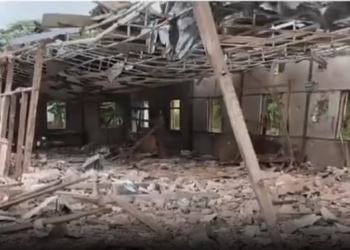
The AAPP report further documented that between 2021 and October 2025, the military council carried out targeted kinetic assaults on more than 470 educational facilities across the country.
Monitors emphasize that these continuous bombardments on educational properties have hollowed out the country’s youth literacy pathways. Furthermore, the report heavily condemned the military’s routine practice of transforming remaining school compounds into heavily armed forward operating bases and structural ammunition depots, a tactical maneuver that strips these institutions of their civilian status and exposes children to immediate frontline hazards.
“The acute crisis enveloping the children of Myanmar has evolved far beyond a localized humanitarian issue,” the AAPP concluded in its formal presentation. “This is a severe structural human rights emergency intimately linked to international legal accountability, child protection mechanisms, and the long-term prospects of national reconciliation.”
The rights group concluded by issuing an urgent manifesto to international governance bodies and foreign democracies, demanding immediate, coordinated intervention to enforce international humanitarian law, halt the global supply lines fueling the junta’s air assets, and protect the remaining vulnerable youth populations inside the war-torn country.