
24 May 2026 By Naing Yarzar Min
At Yangon General Hospital—Myanmar’s oldest and most historic medical institution—a predatory network of extortionists operates with near-total impunity. For ordinary citizens seeking life-saving treatment, navigating the hospital has become a gauntlet of financial exploitation, where bribes are extracted at every turn.
Despite the systemic nature of these abuses, neither the local police nor the ruling authorities have intervened to halt the practice.
Ko Kyaw Kyaw (not his real name), a resident in his 40s, recently arrived at the hospital seeking admission for a critically ill family member. Unable to afford private healthcare, he turned to the state-run institution, unaware of the financial extortion that awaited him.
His ordeal began immediately at the medical registration desk.
“We came here because we simply couldn’t afford a private clinic,” Kyaw Kyaw recalled. “But right at the registration booth, they demanded 3,000 Kyats. They asked for it so brazenly, as if it were an official, legal fee.”
Having paid the initial sum, Kyaw Kyaw secured a bed for his relative. But the demands for money did not stop there.
When the patient required an X-ray, Kyaw Kyaw encountered another layer of the extortion network at the radiology department.
“They told me to ‘give what I could manage,'” he said. “I handed over 3,000 Kyats, but they refused to take it. The staff just stared at me with cold, hardened expressions. It was only when I pulled out a 10,000-Kyat note that they finally accepted it.”
The pattern repeated itself at the laboratory, where the patient was scheduled for routine blood work. There, staff claimed the hospital’s internal laboratory equipment was unreliable, insisting that the samples had to be processed externally—a pretext used to extract further payments.
“They said Yangon General’s labs aren’t accurate enough and that we had to pay to send it outside,” Kyaw Kyaw explained. “We had no choice but to pay. In that environment, you cannot refuse.”
Even daily visits to the ward became a commercial transaction. Security guards stationed at the entrances regularly demand 2,000 Kyats per visitor. Those who cannot or will not pay are barred from entering to see their loved ones.
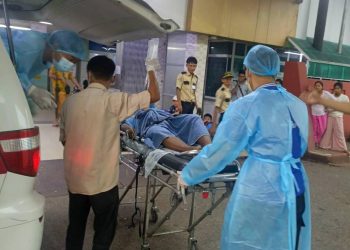
These experiences are far from isolated. Family members arriving at the emergency department with patients in critical condition are routinely intercepted before any medical care is administered.
Fees are levied for every basic service: 5,000 to 10,000 Kyats for a stretcher or wheelchair, and even a “guiding fee” if a relative attempts to walk the patient in themselves.
“If you don’t pay the stretcher-bearers immediately, they retaliate through the patient,” an aggrieved female relative in her 40s shared. “They will deliberately push the wheelchair or stretcher violently, jolting the patient over bumps. For someone fresh out of abdominal surgery, the pain is unbearable. Only when you hand over the cash do they smooth out the ride.”
She added grimly: “These days, patients fear the sanitation staff and the orderlies more than the doctors. When your relative’s life hangs in the balance, you have no choice but to appease them first.”
The exploitation extends even to the most basic human necessities. Public restrooms within the facility are routinely locked by staff, who demand payment before allowing patients or caregivers access.
The most egregious abuses, however, take place at the hospital morgue.
When a patient succumbs to their illness, families face an additional financial hurdle to reclaim the body of their deceased relative. Morgue workers frequently demand sums reaching hundreds of thousands of Kyats under the guise of “funeral administration fees.”
“They demanded 200,000 Kyats just to release the body,” a volunteer from a local humanitarian aid group confirmed. “If the family cannot pay, they hold the body. In the midst of profound grief, families are forced to pay whatever is asked just to give their loved ones a proper burial.”
From registration and diagnostics to ward access, sanitation, and ultimately the morgue, the administrative and support framework of Myanmar’s premier public hospital has been effectively commodified by illicit actors.
Faced with this systemic corruption, senior hospital administrators, physicians, and nurses remain silent, seemingly powerless or unwilling to confront the syndicates. Law enforcement turns a blind eye, and the sitting administration offers no oversight.
For the public, the reality remains stark: those forced to seek care at Yangon General Hospital must bring more than just their medical charts—they must bring a substantial reserve of cash merely to survive the system.
Edited by Ko San