
27 April 2026 By Ko Myo
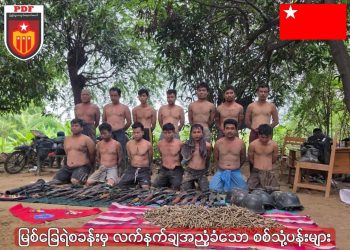
YANGON, Myanmar — More than 60 Myanmar military personnel have either surrendered to resistance forces or been captured on the battlefield during the first three weeks of April, according to data released by the defection support group People’s Goal.
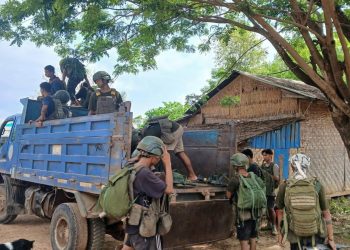
The figures represent a significant blow to the junta’s manpower at a time when it is attempting to enforce a controversial nationwide conscription law. Of the 63 personnel recorded this month, the majority are reported to be new conscripts who chose to abandon their posts shortly after being deployed to conflict zones.
Data from People’s Goal shows a steady increase in desertions throughout the month: 18 in the first week, 15 in the second, and a sharp rise to 30 in the third week of April. Notably, 31 out of the 33 soldiers who defected voluntarily were individuals recently drafted under the People’s Military Service Law.
“We are seeing conscripts surrendering in groups, particularly in strategic areas like Shwegyin and Kyaukgyi,” a CDM officer based near the border told MPA. “The military has responded by increasing threats and internal surveillance to stop these defections, but the trend continues.”
People’s Goal attributed the rising defection rates to the chaotic political climate and the military’s inability to offer a viable future for its soldiers. The group’s statement highlighted the irony of Senior General Min Aung Hlaing calling for “peace” while simultaneously declaring martial law in 60 townships—a move seen as an admission of administrative failure.
“Soldiers are starting to realise that the ‘sham peace’ offered by a ‘sham president’ is not for them,” the group said. “To avoid wasting their lives for a leadership that views them as expendable, more are choosing the path of the people.”
Recent reports from the Myanmar Defense Strategy Institute (MDSI) suggest that many of the defecting conscripts are not merely fleeing, but are actively joining the resistance. In Kyaukgyi Township alone, 41 conscripts joined the Karen National Union (KNU) between January and March 2026.
The high rate of desertion among new recruits underscores the immense difficulty the junta faces in turning unwilling civilians into loyal combatants. While the military command continues to push for more draft batches, the reality on the front lines suggests that the very law meant to save the army may be accelerating its fragmentation.
As the conflict intensifies, the choice between certain death on the battlefield and a life as a defector is one that more of Myanmar’s youngest soldiers are making every day.