
24 April 2026 By Mon Lay
NAYPYIDAW, Myanmar — Myanmar’s military junta has announced plans to review and amend 72 key peace agreements reached during the previous NLD administration, a move analysts describe as a desperate attempt to seek a political exit while facing significant battlefield losses.
During a meeting of the National Solidarity and Peacemaking Negotiation Committee (NSPNC) in Naypyidaw on Thursday, military officials stated they would re-examine the Nationwide Ceasefire Agreement (NCA) outcomes to ensure they align with “existing laws”—a reference widely understood to mean the military-drafted 2008 Constitution.
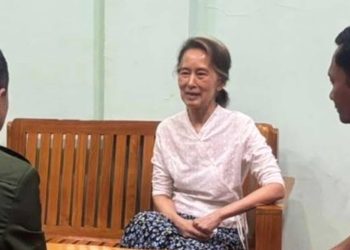
The 72 points in question were the hard-won results of the 21st Century Panglong Conferences held under the civilian government of Aung San Suu Kyi. They represent the foundational principles of a future federal union, negotiated between ethnic armed organisations (EAOs), the government, parliament, and the military.
“The junta is using these results as a tool to cover up their military failures,” a political activist told MPA. “By saying they need to align these points with ‘existing laws,’ they are trying to trap ethnic aspirations within the 2008 Constitution, which only serves to protect military power. There is no hope for genuine federalism here.”
Lieutenant General Min Naing, Secretary of the NSPNC, claimed the review is necessary for legal consistency. However, observers point out that the junta’s sudden interest in the peace process follows the declaration of martial law in 60 townships just 24 hours earlier.
“It is nonsensical to talk about peace while simultaneously imposing martial law across the country,” a local resident said. “The public sees through these tricks. It’s a stalling tactic by a regime that is nearing its end.”
The military’s proposal also included plans to seek assistance from neighbouring countries and use media channels for propaganda in border regions. Despite these overtures, the majority of EAOs currently fighting the regime remain steadfast in their refusal to engage.
“Most ethnic groups have zero trust in the junta’s offers,” a political analyst noted. “They have made it clear that the revolution will continue on the battlefield. The junta’s attempt to drive a wedge between resistance forces using these old political games is unlikely to succeed.”
As the civil war enters its sixth year, the military’s attempt to resurrect and reshape the peace process is being viewed not as a gesture of reconciliation, but as a calculated effort to buy time and dismantle the democratic legacy of its predecessors. For the people of Myanmar, the focus remains on the total eradication of the military dictatorship rather than another “sham” peace table.