
By Hsu Yee 14 April 2026
Analysis — In the murky corridors of Naypyidaw, a persistent rumor once circulated: Beijing was looking for a new face to lead Myanmar’s military government—anyone but Min Aung Hlaing.
The speculation intensified after the first phase of the junta’s widely condemned general election on December 28, 2025. China’s “Governor of Naypyidaw,” Deng Xijun (the Special Envoy for Asian Affairs), had initially boasted that the polls were a consensus reached between Min Aung Hlaing and Chinese President Xi Jinping. Yet behind the diplomatic smiles, Beijing’s frustration with the defiant Senior General remains one of the region’s worst-kept secrets.
While the Chinese government has never officially called for his removal, the logic of their “big power” diplomacy makes it plausible. Beijing thrives on playing the “elder brother” role, issuing guidelines to smaller, dependent nations. Min Aung Hlaing and his inner circle are alive today solely because of China’s protective umbrella. Had Beijing remained a silent bystander during “Operation 1027,” the General and his cohort would likely be in exile in Russia by now, nursing their losses with vodka.
A History of Flip-Flopping
China’s meddling began shortly after the 2021 coup. Initially, Beijing adopted a “gentlemanly” facade, echoing the international community and ASEAN’s Five-Point Consensus. However, as it became clear that Min Aung Hlaing would not be swayed by diplomacy, Beijing’s stance shifted.
By 2022, following former Cambodian Prime Minister Hun Sen’s visit to Naypyidaw, China began parroting the junta’s “Five-Point Roadmap” as a viable alternative. This led to Beijing’s preferred “quick fix”: hold an election and allow the National League for Democracy (NLD) to participate. To China, this was a “win-win” scenario that conveniently ignored the National Unity Government (NUG), the People’s Defence Forces (PDF), and ethnic resistance groups.
The “Aung San Suu Kyi” Phobia
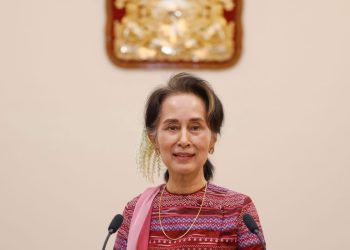
Min Aung Hlaing flatly rejected China’s prescription. On March 28, 2023, he officially dissolved 40 political parties, including the NLD. His mission was clear: erase Aung San Suu Kyi and the NLD from Myanmar’s political landscape forever. Driven by a deep-seated fear of “The Lady” and the knowledge that the military-backed USDP would never win a fair fight, Min Aung Hlaing ignored Beijing’s advice. He didn’t just dissolve the party; he ordered the physical destruction of NLD offices nationwide.
For a time, the tension was palpable. During the July 2022 Lancang-Mekong Cooperation meeting in Bagan, Chinese Foreign Minister Wang Yi notably refused to grant Min Aung Hlaing a formal audience. Later, in October 2023, the General was conspicuously excluded from the “Belt and Road” forum in Beijing, a snub that reportedly caused significant anger in Naypyidaw.
From Snubbed to Essential
However, the geopolitical landscape shifted with the second phase of Operation 1027. When resistance forces began threatening Mandalay, Beijing realized the junta was on the brink of collapse. Unwilling to look past a military-centric political model, China stepped in openly in August 2024 to prevent the junta’s total demise, brazenly interfering in Myanmar’s internal affairs.
Today, through a sham election supported by China, the man Beijing once hoped to replace has declared himself “President.” Why was China originally hesitant to see him in this role? Because in Min Aung Hlaing’s dictionary, the word “negotiation” does not exist. Beijing had fantasized that a new figurehead might ease international pressure and be more amenable to a negotiated settlement.
The Despot’s Bargain
Caught in a corner and fueled by paranoia, Min Aung Hlaing has tightened his grip on power. Consequently, President Xi was forced to send a congratulatory message, and the Chinese Ambassador had to rush to Naypyidaw to honor the “elected” leader. China is now effectively a passenger on a train driven by Min Aung Hlaing’s whims.
The Senior General knows that without his titles and the shield of power, his life is over. He is well aware of the international warrants and the justice that awaits him. His deal with China is simple: “Give me support, give me protection, and you can have anything you want in Myanmar—just don’t touch my power.”
In the tragic theatre of Myanmar’s politics, China has found itself tied to a despot it dislikes, propping up a regime that continues to plunge the country into ruin, all for the sake of its own strategic interests.