
THANDAUNGGYI, Myanmar — A major tragedy was narrowly avoided in Kayin State on Friday after ethnic Kayan forces successfully deactivated several improvised landmines planted along a road used daily by local farmers.
The explosives were discovered by villagers on the route connecting Kyay Ka Tot and Tawpone Middle Village in Thandaunggyi Township. The path is a vital artery for the local community, many of whom rely on subsistence farming in the surrounding hills.
Upon spotting the suspicious objects, terrified residents immediately contacted the People’s Administration of the Kayan New Land Council (KNPC).
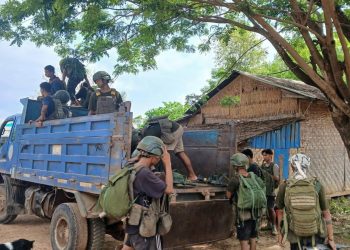
“Kayan security units were dispatched to the scene as soon as the report came in,” a local administrative official told MPA. “They were able to systematically search and remove the devices without any casualties. If these had not been found in time, we would be looking at a catastrophic loss of life among our farmers.”
While it remains unclear which armed group was responsible for planting the mines, the incident has sent shockwaves through the local community. Myanmar is currently one of the most landmine-contaminated countries in the world, with both the military junta and various armed groups utilizing them in the ongoing civil war.
“We don’t know who planted them, but we are now terrified even to go to our farms,” a local resident said. “These are civilian roads. We appeal to all armed groups to stop planting mines where people have to walk every day to survive.”
Following the incident, the KNPC has ramped up security patrols and area clearance operations along key village routes to ensure no further devices are hidden in the brush.
“The successful removal of these mines was only possible because of the strong communication between the residents and our team,” a KNPC spokesperson noted. “However, the threat remains high, and we are advising everyone to move with extreme caution.”
Since the military coup in 2021, the use of landmines has surged across central and eastern Myanmar. For agrarian communities like those in Thandaunggyi, the presence of these “silent killers” represents not just a physical danger, but a direct threat to their economic survival.
As the conflict shows no sign of abating, the lives of ordinary citizens continue to be caught in a deadly crossfire, where even the simple act of walking to work has become a high-stakes gamble.