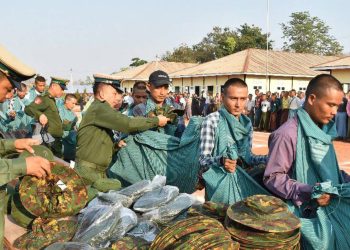

In the early days of the revolution, which began with basic flintlock rifles (Tumi), the surge of “Thauk-Po” (Revolutionary Supporters) and their financial contributions provided immense momentum. From frontline needs like weaponry and ammunition to rear-line essentials such as medicine, food, and general expenses, the logistics sector never faltered in its duty.
However, as the revolution surpasses the five-year mark, the public is weary under a blanket of multifaceted crises. Yet, despite the exhaustion, the people’s resilience remains unbroken.
The Struggles of the Heartland
In the central plains (Anyar region), residents have lost their homes and livelihoods due to the military junta’s scorched-earth policy. Despite having no fixed place to sleep or eat, their revolutionary spirit remains firm. In 2022, locals were famously donating their personal gold jewelry to fund the resistance. Today, the reality is grimmer; forced displacement, the inability to farm, and a severe financial crunch mean they can no longer contribute as they once did.
“People simply can’t donate cash like before, but they still provide ingredients and rations. While there are moments of discouragement, their spirits ignite the moment a battle breaks out. They immediately ask what is needed and start preparing food parcels for the troops,” says Ko Min Min (alias), a logistics volunteer in Pale Township.
Economic Blows and Digital Threats
The global oil crisis triggered by Middle East conflicts has trickled down to Myanmar, directly impacting the agricultural sector. In the Anyar region, farming—the backbone of the local economy—is stifled by both active conflict and the soaring cost of fuel.
In urban areas, residents face a different set of pressures: hyperinflation, the junta’s oppressive restrictions, and the constant threat of forced conscription. A Yangon-based donor shared that her monthly contributions have plummeted from over 10 million MMK in the early stages to barely 400,000–500,000 MMK today.
Furthermore, the junta’s implementation of the CEIR (Central Equipment Identity Register) system in March 2025—designed to disable mobile phones and track users—has severely threatened personal security and complicated the use of e-payment systems, which are vital for domestic funding.
Shifting to Self-Sustenance: “The Hoe and the Rifle”
With domestic funding declining, revolutionary groups are increasingly relying on the diaspora (overseas supporters). However, even international fundraisers report that hitting targets in 2025 requires double the effort compared to previous years.
In response, resistance forces are shifting toward a strategy of self-reliance. Many units are now farming rice and vegetables or raising livestock (poultry and pigs) within their camps to secure their own food supply.
“For units to engage in small-scale farming is no longer an option; it is a strategic necessity for long-term survival,” says a spokesperson for the Yinmabin District Battalion 30 (ADPRA). “Growing our own food can reduce the ration budget by more than 50%.”
Internal Challenges and the Path Forward
The revolution also faces internal hurdles. Armed conflicts between allied groups (inter-FRI conflicts) have begun to erode public trust and donor confidence. Ko Thet Hnin Aung, Chairman of the Prome District Basic Education Students’ Union, notes that such incidents, coupled with rigid “centralized funding” policies that sideline local units, create significant hurdles for many groups.
As of early 2026, the National Unity Government (NUG) oversees hundreds of battalions and People’s Defense Teams (PaKaPha) across 10 military regions. Yet, many units—both under the NUG and local independent forces—continue to struggle for basic resources.
The consensus among frontline leaders is a return to grassroots principles. One revolutionary in Yinmabin summed it up: “We must strictly oppose using weapons for financial gain. To survive a long-term war, battalions must coordinate with local farmers and create a new socio-economic system. A soldier today must hold a rifle in one hand and a hoe in the other.”
Edited by: Ko Sann