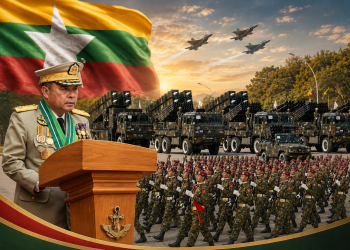

While the people of Myanmar struggle with a crippling fuel crisis—exacerbated by the spillover of the conflict in Iran—the military commission’s “killing machines” seem to have no shortage of aviation fuel. Across the country, civilians are forced into “odd-even” rationing systems for their daily commute, yet the sky remains thick with fighter jets that know no rest.
In a desperate bid to conserve fuel for the war effort, domestic flights have been canceled and passenger weight limits strictly enforced. But for the junta’s pilots, there are no holidays and no rationing. Their mission is singular: the systematic bombardment of their own people.
A Trail of Blood Across the Map
The month of March has been a grim testament to this aerial brutality. From the killing of civilians in Nyaunglebin on March 5 to the repeated strikes on a prisoner-of-war camp in Ann on March 8, the pattern is clear. On March 9, bombs fell on a Christian church in Palaw where children were studying the Bible.
However, the most recent atrocities in Katha and Kani (March 20–21) have struck at the very heart of Myanmar’s cultural and religious identity: the Buddhist monkhood.
The Massacre at Maha Lay Htat
On the morning of March 20, as the junta’s illegal regional assemblies were in session, a jet fighter targeted the Maha Lay Htat Monastery in Katha. This was no “collateral damage” or accidental strike on an obscure building.
The monastery is a vast, historic landmark, home to the famous Tawadeintha Maha Pagoda and formerly the residence of the revered Manle Sayadaw. It was well-known to the military—who control Katha town—that the monastery was a sanctuary for displaced civilians (IDPs).
The bombs were dropped exactly as the monks and refugees were gathered for their morning meal. The result was a scene of carnage: bodies torn apart, robes soaked in blood. Reports indicate that over 50 monks and civilians were killed instantly.
The following day, the assault continued in Kani Township. Eight fighter jets spent thirty minutes pounding the Su Lay Kone Monastery and its adjacent school. While the school was empty, photographs later emerged showing the monastery engulfed in flames and the lifeless body of a monk lying in a pool of his own blood.
The Crisis of Silence
The military’s tradition of killing monks and destroying sacred sites is no longer a surprise. What is increasingly shocking, however, is the profound silence from the high-ranking clergy and official religious bodies.
The contrast in reaction is jarring:
- The Scandal of the “Ordination Hall”: In February, when a video went viral of a couple acting inappropriately in a monastery in Pyawbwe, “defenders of the faith” rose up in a fury, demanding the harshest punishments for the “insult” to religion.
- The Silence of the Slain: When that same religion is insulted by 500-pound bombs, when monks are sacrificed like ritual offerings for the junta’s power, these same “defenders” remain mute. Apparently, a couple’s indiscretion is a threat to the faith, but a mass murder is not.
A History of Impunity: The Win Nimmita Case
This silence is a learned behavior. In June 2024, the military shot and killed the highly respected Win Nimmita Sayadaw in Ngazun. The junta initially blamed the PDF, a lie that was only debunked because of the courage of the Kan Thone Sint Sayadaw, who survived the attack and refused to change his testimony despite being denied medical care as a form of torture.
Despite the junta’s eventual “admission” and promise of an investigation, no one has been held accountable. The case has been swept under the rug, and the Sayadaw’s disciples have retreated into “patience,” as if their duty ended with the scattering of his ashes.
The Vanishing “Saffron” Spirit
The spirit of the 2007 Saffron Revolution—where monks stood as the moral vanguard against tyranny—appears to be flickering out, replaced by a paralyzing fear.
By turning a blind eye to the slaughter of their peers and continuing to accept “alms” from the hands of killers, the religious establishment is inadvertently emboldening the military to continue its campaign. When monks ignore the screams of the people, and then ignore the screams of their own brothers, they do more than lose their moral authority—they provide the junta with the fuel of complicity.
In the eyes of the world, this silence is becoming the greatest shame of the Myanmar monkhood. Until the clergy realizes that the survival of the Dhamma is inextricably linked to the survival of the people, the blood on the robes will only continue to dry.