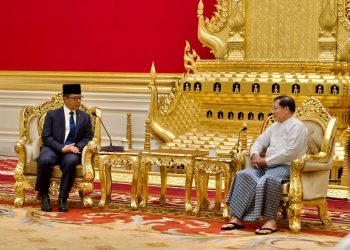

The current military and political landscape in Myanmar is shrouded in a complexity that goes far beyond conventional warfare. For those tracking the maneuvers of regional superpowers, the signals are increasingly ominous. Following the Kunming ceasefire talks, the military commission appears unable to resist China’s gravity, seemingly trading national sovereignty for its own institutional survival.
The Looming Shadow of Beijing
Pro-military lobbyists have recently pivoted to a new narrative, arguing that the Tatmadaw must prove itself a “trustworthy friend” to China. This rhetoric is a transparent admission of fragility; the military can no longer stand on its own feet and is openly pleading for a Chinese umbrella.
However, Beijing’s calculus is driven not by the junta’s welfare, but by its own Belt and Road Initiative (BRI) projects and border stability. The military’s willingness to act as a client state to maintain power provides the revolutionary forces with a significant strategic opening.
The “Puppet” Parliament
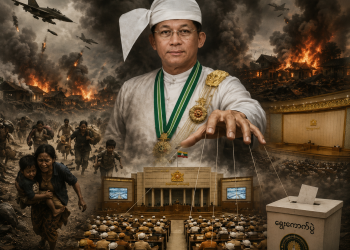
In a move widely seen as a defiance of popular will, the military commission has pushed forward with a sham electoral process, convening the People’s Assembly yesterday. This is a calculated political theater designed to signal “legitimacy” to China and the international community—a desperate attempt to rebrand a coup-regime as a legal government.
The Revolutionary Counter-Strategy
For the National Unity Government (NUG), Ethnic Revolutionary Organizations (EROs), and the People’s Defense Forces (PDF), the path forward requires a pragmatic shift in diplomacy.
- Protecting Interests: The resistance must demonstrate that they can protect the China-Myanmar Economic Corridor (CMEC) more effectively than the military. By leveraging grassroots support, they can offer a brand of stability that a hated military regime never can.
- Unity Over Division: Internal territorial disputes among EROs, particularly in Northern Shan State, must be resolved internally. If the resistance fails to mediate its own conflicts, it leaves the door wide open for China to employ “divide and rule” tactics.
- Diplomatic Diversification: While Western support is vital, it is insufficient. The revolution must engage in “parallel diplomacy,” assuring neighbors like China and India that a federal democratic future will not jeopardize their regional interests.
Governance as the Ultimate Exit
The most potent political exit for the revolution lies in the establishment of robust local administrations in liberated zones. By proving that governance without the military is not only possible but more just and efficient, the resistance systematically dismantles the junta’s raison d’être.
“The revolution must flip the script: while China views the military as the ‘lead actor’ in Myanmar’s stability, the resistance must prove on the ground that the people are the true protagonists of the nation’s future.”
A Warning on Resources
The resistance must broadcast the military’s fire-sale of national resources to the world. A clear, firm stance must be maintained: any contracts or resource concessions made by the junta are illegal and will not be honored in a future Federal Union.
Conclusion: The Path to a Federal Future
The alignment between Beijing and the junta is a marriage of convenience, likely to be temporary. China is pragmatic; it seeks stability above all. If the EROs and PDFs can demonstrate a unified political and military front—showing they are more effective at combating border crime and ensuring peace—Beijing’s policy of relying on the military will inevitably shift.
The true “exit” is not a compromise with tyranny, but a steadfast adherence to the total eradication of the dictatorship. By combining military gains with diplomatic sophistication and inclusive governance, the revolution can navigate the currents of superpower interests to build a sovereign, federal democracy.