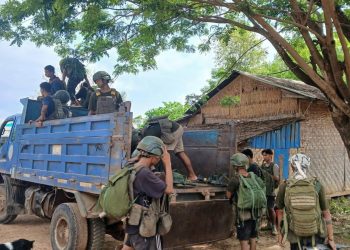

The Chief Minister of the Indian state of Mizoram, Lalduhoma, has confirmed that the Kaladan Multi-Modal Transit Transport Project (KMMTTP), a critical joint infrastructure venture between India and Myanmar, is now under the full control of the Arakan Army (AA).
Addressing the state assembly on 11 March 2026, the Chief Minister stated that the project is no longer under the authority of the Myanmar military junta. According to reports by The Assam Tribune, Lalduhoma emphasized that the Arakan Army has expressed a strong desire to see the long-delayed project successfully completed.
The Chief Minister’s remarks signal a significant shift in regional dynamics, highlighting a functional relationship between the Mizoram state government and the ethnic armed group. “We maintain a good relationship with the Arakan Army and continue to foster our ties,” Lalduhoma told the assembly.
Political analysts suggest this acknowledgement reflects a “pragmatic” turn in Indian foreign policy. While New Delhi has traditionally engaged exclusively with the central authorities in Naypyidaw, the reality on the ground has forced a re-evaluation. “The Mizoram government’s statement proves that they now recognise the Arakan Army as the de facto authority in the region,” one observer noted.
Despite the burgeoning relationship, the Mizoram government remains concerned over the rise of informal and unregulated trade across the border between Mizoram’s Lawngtlai district and Paletwa in Myanmar’s Chin State. The Chief Minister pointed out that the collapse of the military junta’s administrative grip has made border management increasingly difficult, as essential goods continue to flow steadily into Myanmar through unofficial channels.
Economists argue that the Kaladan project remains an indispensable strategic asset for India, providing a vital link to its landlocked northeastern states. “India seems prepared to cooperate with whoever is effectively working on the ground to ensure the project’s success,” an economic expert told the Myanmar Pressphoto Agency (MPA).
The loss of control over such a high-profile strategic project is seen as a major blow to the international standing of the Myanmar military council. Military experts suggest that the Arakan Army’s dominance in Paletwa and Rakhine State has not only secured territorial gains but has also opened a “diplomatic gateway” to international engagement.
In response to the evolving situation, the Mizoram government has established a study team to monitor the impacts of the Kaladan project. Future policy decisions will be based on the team’s findings, further cementing the Arakan Army’s role as an unavoidable partner for Myanmar’s neighbours.
While it remains to be seen how far India’s central government will go in formalising relations with the AA, at the state level, the ethnic armed group has firmly established itself as an essential collaborator in the region’s geopolitical and economic future.