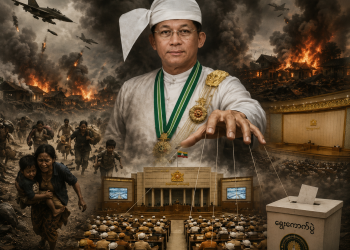

As is the custom with Senior General Min Aung Hlaing’s “pointed-finger” style of management, his latest decree has once again plunged the public into a state of utter pandemonium.
Marketed as a fuel-saving measure, the military council announced on the night of 3 March that, due to the ongoing conflict between the US, Israel, and Iran and the resulting disruptions to maritime fuel routes, private vehicles would be restricted starting 7 March. Under the new “Odd-Even” policy, cars are only permitted to be on the road every other day, based on the final digit of their license plates. Failure to comply, they warned, would result in legal action.
While the public was already braced for fuel woes following the outbreak of the regional conflict on 28 February, the sudden, aggressive nature of the announcement sent shockwaves through the country. By the morning of 4 March, massive queues snaked from fuel stations nationwide.
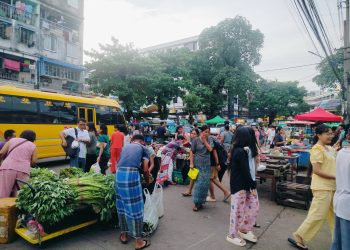
In major cities, the scene was one of desperation. Fuel stations, unable to meet the surge, began rationing sales. Driven by a profound distrust of the military council, citizens feared that a total fuel exhaustion was imminent. People spent their days in endless lines, rushing home to siphon fuel into bottles and containers before returning to join the queue once more. In provincial towns where motorcycles are the lifeblood of transport, the chaos was even more pronounced.
Sensing the growing unrest, the military council’s spokesperson, Zaw Min Tun, scrambled to issue a statement via lobbyist channels on the evening of 4 March, claiming that the country held a 40-day reserve of fuel and that more tankers were due to arrive shortly.
The move drew sharp criticism from the former Information Minister and ex-political prisoner, U Ye Htut. On his Facebook page, he noted that the council should have announced the 40-day reserve before the restrictive policy to ease public anxiety. He further suggested that a system of rationing sales based on the “Odd-Even” digits—rather than restricting movement entirely—might have been more practical. One commenter beneath his post summed up the public sentiment: “Those people [the council] just don’t have the brains for that.”
Despite Zaw Min Tun’s reassurances, the morning of 5 March saw no relief, with citizens continuing to sweat in long lines. While official stations rationed fuel, a thriving black market emerged where those with enough cash could buy as much as they needed at inflated prices. In Yangon, the lines reportedly began to thin slightly by 6 March.
The policy officially took effect on 7 March, though the council designated the first week as an “educational period.” However, in Yangon, this “education” quickly transformed into an extortion racket. Reports flooded social media of traffic police and “joint task forces” demanding bribes—some as high as 20,000 kyats—from drivers of “even” cars caught on “odd” days. Consequently, the city’s once-congested roads became eerily quiet.
The “Odd-Even” drama also extended to the pumps, where stations limited sales to 50,000 kyats per vehicle, strictly adhering to the daily digit rule. For Yangon’s cars with clear single-digit suffixes like 2A or 4A, the rules were straightforward. The real headache, however, was for motorcycles in other cities.
The council’s poorly drafted directive focused on single-digit examples but failed to clarify rules for two-letter suffixes common on motorcycles, such as 63W or 41W. This lack of clarity led to a “one school, one mantra” situation in Mawlamyine, where some stations looked at the first digit, others at the last, and some even tried to calculate based on divisibility by two. The military council has offered no clarification, leaving a vacuum that traffic police have been more than happy to fill with their own profitable interpretations.
“The confusion is a goldmine for the traffic police,” a Mawlamyine local remarked. “They just calculate the digits however they want to demand money.”
While a bribe might settle the matter during the “educational” phase, the threat of imprisonment looms from 14 March. Without official clarification, the “Odd-Even” farce is set to become even more tangled.
Beyond the chaos, many question whether this “entrepreneurial” scheme by Min Aung Hlaing—unseen in any other nation—is actually effective. An electronics businessman in Yangon noted that the rationing makes little difference to him; instead of filling up every few days, he simply tops up with 50,000 kyats whenever his digit allows. On days his car is banned, he simply takes a taxi to finish his urgent work, resulting in zero net fuel savings.
“The only people benefiting from this mess are the police and soldiers catching cars,” he added. “It’s like their boss has opened a new revenue stream for them.”
A social worker in Mawlamyine observed that the restrictions have done little to curb the black market. Station employees are reportedly siphoning fuel to illicit sellers, and the hoarding by panicked citizens continues. Meanwhile, the most tangible result for the public has been the immediate spike in food prices.
Global oil prices are hovering around $100 per barrel as the conflict in the Middle East escalates. With Iran’s new leadership signaling continued defiance against the US and Israel, and the strategic Strait of Hormuz becoming increasingly dangerous for shipping, fuel costs are expected to climb further.
For a military council on an international blacklist with dwindling dollar reserves, the outlook is bleak. Since their primary objective is self-preservation, the welfare of the public is a distant concern. It is highly likely that even more draconian measures and higher inflation are on the horizon.
Yet, while the rest of the world navigates these treacherous economic waters with caution, the “management expert” Min Aung Hlaing remains unbothered. At a Finance Commission meeting on 6 March, he optimistically projected a 3.4% economic growth rate for the 2026-2027 fiscal year under his illegitimate government.
It was a performance so detached from reality that it could almost be mistaken for comedy. Perhaps that is the ultimate management skill of Min Aung Hlaing: to remain perfectly composed while the country burns, so long as he doesn’t have to let go of his power.