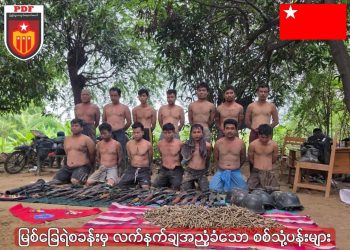

Conflict has intensified in Sagaing Region’s Pale Township, with reports of significant casualties on both sides as junta forces launch a major offensive to resupply pro-military militia villages with food and ammunition.
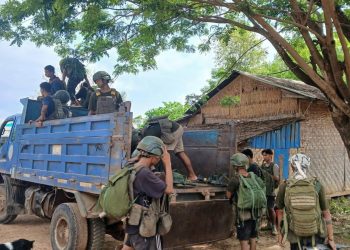
According to local sources and resistance fighters, a military column that has been stationed in Chin Pyit village since 24 February began advancing through several villages, including Nghet Pyaw Taw and Chin Pyit Kyin, toward Mon Thwin village. On 28 February, this column was intercepted by local resistance forces, leading to fierce clashes.
The Myanmar military reportedly responded with heavy air support, utilizing jet fighters and gyrocopters to bombard resistance positions. “The military’s heavy reliance on air strikes suggests they took significant hits on the ground,” a local source told the Myanmar Pressphoto Agency (MPA). “However, we have information that at least five resistance fighters were killed in the engagement”.
The offensive comes in the wake of the high-profile surrender of BNRA leader Bo Nagar on 18 February. Since 21 February, the military has deployed two separate columns to secure territory along both sides of the strategic Pale-Gangaw highway.
On 2 March, the military reportedly utilized aircraft to drop supplies twice—at 09:00 and 14:00—to the pro-junta Pyu Saw Htee stronghold of Zee Phyu Kone. Later that evening, further air strikes were reported in the southwestern part of Pale Township, coinciding with a widespread shutdown of telecommunication lines in the area.
The renewed violence has triggered a fresh wave of displacement. Residents from over 26 villages, including Yin Paung Taing and Min Tine Pin, have been forced to flee. Many of these civilians have been living in displacement since June 2025, when fighting first intensified in the region. “Previously, resistance forces were able to inflict heavy damage on moving columns with landmines and ambushes,” one displaced woman remarked. “We hope to see that level of unified resistance again”.
As the military continues its efforts to consolidate control over the Pale-Gangaw corridor, the humanitarian situation for thousands of displaced villagers remains dire, with access to food and safety increasingly restricted by the ongoing military operations.