
The casual greeting among friends, “Are you doing okay?”, has long been obsolete in Myanmar’s social circles. It has reached a point where asking feels redundant because those who are actually “okay” have become a rare species. Everyone is submerged in their own sea of struggles, and since few have the capacity to help others, many have simply learned to look away. These hardships, though easy to talk about, are agonizing to face, yet they have taken root in this dark era like a stubborn, climbing vine that refuses to be cut.
A witty uncle, born and bred in Yangon, put it with a cynical laugh: “When things got bad, I went to the teahouse at the head of the street to mope. It was only then, seeing so many others looking just as miserable as me, that I actually felt encouraged.”
This man is a GTI graduate engineer in his 50s. For most of his life, he enjoyed a smooth professional career as a versatile engineer. Midway through the NLD government’s term, he took a leap of faith to become a small-scale construction contractor. His honesty and skill kept him busy, often managing two or three sites simultaneously. He spent his days driving his own car between project sites; he was busy, but his life was prosperous.
When the military seized power, his life hit a wall as if someone had slammed on the emergency brakes. Work stopped abruptly. He lost the will to build. Instead, he joined his former classmates at the Hledan junction, their regular gathering point, to raise his fist in defiance against the military council.
It was only in 2022 that he dipped his toes back into the construction industry, but it was a far cry from the old days—now, it was just enough to keep food on the table. He looked around for other opportunities, but every engineering job he knew how to do was stagnant. He had no choice but to try and stand his ground in construction.
“In 2023, things seemed to improve slightly, so I had high hopes for 2024,” he explained. “But then the military council tightened import licenses. Construction material prices went haywire, and from that moment on, we were just spinning our wheels.”
By the end of 2024, material prices had skyrocketed, leaving contractors in a state of panic. Construction projects operate on fixed-price contracts signed in advance. Because prices jumped so violently and contractors couldn’t ask for more money from clients, many found themselves financially suffocated.
The story is the same for his peers. A friend who ran an air-conditioning company with over 60 employees during the NLD era was reduced to a skeleton crew of 10 by 2023, barely keeping the doors open. Specializing in air conditioning was no longer enough; he had to take on jobs completely unrelated to engineering just to survive. He remarked that in this era, even working two jobs feels like you’re barely gasping for air.
Because death isn’t an option and a family cannot go hungry, the engineer began moonlighting as a real estate and car broker. Now, he has become a full-time broker.
By 2025, the lack of import licenses caused material prices to surge again. Following a major earthquake in Sagaing on March 28, even cement became unavailable in Yangon. He tried to pace his last two projects slowly, hoping prices would drop after the Thingyan festival. They didn’t. To avoid further losses, he rushed to finish the remaining work and closed the chapter on his career as a contractor.
“There is work in Naypyidaw clearing buildings damaged by the earthquake. It pays well, but it would mean collaborating with the military, so I refused,” he said.
When his business stopped, his crew of over 20 daily-wage workers was left adrift. Some took odd jobs; others became gambling agents, sidecar drivers, or even joined the ranks of thugs under the “Pyusawhti” militias to sell WY stimulant pills. They bent their lives in whatever direction they had to in order to survive.
“I knew 20 families would lose their footing, but I was drowning myself, so I had to close my eyes to it,” he continued. He noted that another engineer friend saw his business and marriage collapse before fleeing back to Singapore to resume life as a corporate employee.
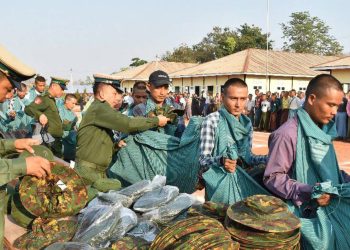
Today, the engineer brokers houses and cars. He exports goods commonly used by the Myanmar diaspora to Singapore and Thailand. He even helps ship the dried snacks his wife makes. He is working jobs he never even dreamed of, sweating just to avoid being forced out of Yangon. Despite being over 50, he stays vigilant to avoid being snatched in a “press-gang” for military service, rushing home as soon as evening falls.
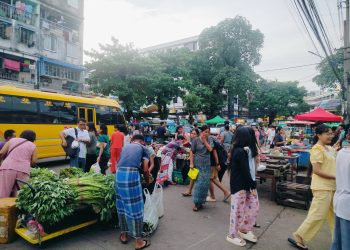
In Yangon, even the middle class is in the “emergency room.” Housewives must fight to keep their sanity as they face the market prices. The city is a mix of those who want to die and those who want to kill. While the military uses threats and handcuffs to artificially suppress gold prices that have surged past 10 million kyats, the reality is clear to everyone—it isn’t dropping back below that mark. No one in Yangon is laughing; everyone is just staring blankly.
Beneath the surface, Yangon is boiling with a single thought: Where is tomorrow’s meal?