
While blaming “power-hungry” rivals for the nation’s collapse, Senior General Min Aung Hlaing has spent the last five years consolidating an unprecedented collection of titles and authority. As a new “sham” government looms, his endgame is becoming clear.
In a recent message marking the 78th Chin National Day, the leader of Myanmar’s military junta, Min Aung Hlaing, made a claim that many found darkly ironic. He asserted that the country’s current state of civil war and crushing poverty was the fault of “power-hungry individuals.”
For a man who seized power by force from a civilian government and currently holds every major executive lever in the country, the statement drew widespread ridicule. To observers, it was a classic display of psychological projection from the man who is the primary architect of the nation’s instability.
The Accumulation of Power
Min Aung Hlaing’s journey toward absolute rule began on 1 February 2021, when he overthrew the elected NLD government under the pretext of unsubstantiated voter fraud. Since then, he has engaged in a relentless pursuit of titles that has seen him hold more concurrent positions than any dictator in Myanmar’s history.
After appointing himself Prime Minister six months after the coup, he later assumed the role of Acting President on 31 July 2024, citing the ill health of the military-appointed Vice President Myint Swe. By military decree and self-appointment, he now controls the legislative, executive, and judicial branches of the state.
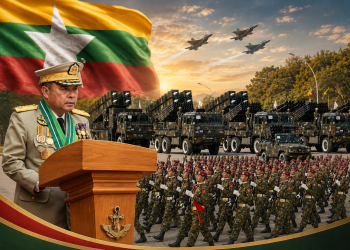
However, this absolute control has come at a staggering cost. International and domestic monitors estimate that over 25,000 civilians have been killed during his tenure, with more than 3.6 million people displaced. Heartbreakingly, over 10,000 of the dead are women and children—a grim testament to a rule maintained through state terror.
A “Doctorate” in Devastation
The General’s hunger for status extends beyond political offices to honorary titles. He is often mocked as a “title-seeker,” having amassed nearly a dozen honorary degrees and state awards, most of which he effectively conferred upon himself.
As recently as 5 February, he accepted an honorary doctorate from Yangon University, presented by his own appointed Education Minister. This followed his self-conferment of two of the nation’s highest civilian honors—Thadoe Thiri Thudhamma and Thadoe Maha Thray Sithu—titles traditionally reserved for those who have rendered exceptional service to the nation.
To his critics, the sight of a leader accepting awards for “systematic management” while the national economy lies in ruins and the military relies on forced conscription to fill its depleted ranks is a display of profound shamelessness.
The Next Act: A Scripted Transition
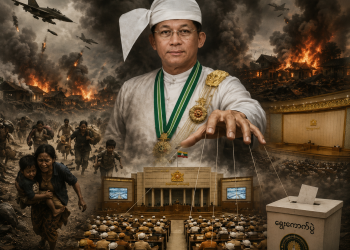
Min Aung Hlaing is now preparing for his next political evolution. To provide a veneer of legitimacy to his rule, he orchestrated a “sham” election held in three phases between December 2025 and January 2026.
With his proxy party, the USDP, claiming a scripted landslide victory, a new government is set to emerge in April. The question now occupying analysts is not whether he will relinquish power, but what form his new role will take.
The recent enactment of the “Union Advisory Council Law” on 3 February 2026 suggests a maneuver similar to the creation of the State Counsellor role in 2015. Speculation is rife that he may resign from his military post to become President, while simultaneously holding the title of Union Counsellor to maintain a grip on the new administration.
Whether he moves from the Commander-in-Chief’s office to the Presidential Palace, or continues to pull the strings from the shadows, one thing remains certain: Min Aung Hlaing’s “power game” is far from over. For the people of Myanmar, however, the changing of his titles offers little hope for a change in their desperate reality.