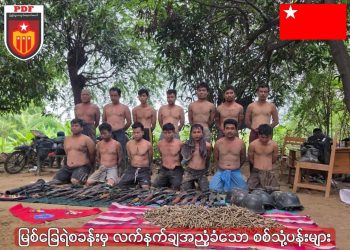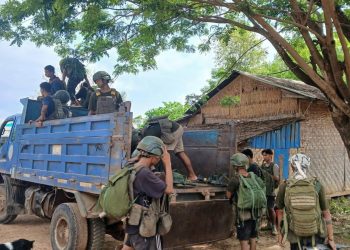

The Myanmar military has intensified its aerial bombardment in Karen State as it struggles to defend its final remaining strongholds in the strategic border town of Hpapun, local resistance fighters report.
A fierce battle erupted in early February when junta troops, currently trapped within a tactical command center and nearby battalion bases, attempted a breakout after being under siege for nearly a year. Karen revolutionary forces, led by the Karen National Union (KNU) Brigade 5 and People’s Defence Forces (PDF), have maintained a tight blockade of the area since March 2024.
“The troops have been trapped in that tactical base for a long time. Food and supplies are critically low,” a military source close to KNU Brigade 5 told the Myanmar Pressphoto Agency (MPA). While the military has attempted to air-drop supplies, many have reportedly fallen into the hands of resistance groups. “The pressure has become unbearable after nearly two years, which is likely why they tried to push out, triggering this latest round of intense fighting,” the source added.
While resistance forces captured Hpapun town and three light infantry battalions in March 2024, they have yet to seize the Tactical Command Base and Light Infantry Battalions 340 and 341. Resistance groups estimate that over 500 people—including soldiers, non-CDM civil servants, and their families—are currently huddled together within the remaining besieged perimeter.
The military has responded with near-constant airstrikes and heavy artillery to repel the resistance advance. “The fighting has lasted for over three weeks now. They are using heavy artillery and air support daily,” a fighter on the ground said. Ground reinforcements are reportedly attempting to reach Hpapun from Kataingti village, 30 miles to the south, involving forces from the Karen Border Guard Force (BGF) and a breakaway DKBA faction.
The fighting has been so close that some airstrikes have reportedly caused “friendly fire” casualties among junta troops. According to figures from the National Unity Government (NUG), 57 clashes took place in Hpapun between February 1 and 15, resulting in at least six junta fatalities and 20 injuries.
Hpapun is considered a vital military gateway. If the remaining bases fall, it would open a corridor for revolutionary forces to advance toward Naypyidaw, Bago, and Mon State. This strategic importance explains the military’s desperate and sustained effort to hold the position at any cost.