
By Poe Sangle / MPA
Tensions within Myanmar’s powerful anti-junta coalition have boiled over into armed clashes between two major ethnic rebel armies, sparking fears of a broader turf war in northern Shan State.
Fighting has erupted in Kutkai Township between the Myanmar National Democratic Alliance Army (MNDAA) and the Ta’ang National Liberation Army (TNLA)—two deeply armed factions that have previously fought alongside each other against the military government.
The clashes, driven by a dispute over territorial control, are raising serious concerns among local civilians and the wider resistance movement.
The conflict reportedly ignited on 13 February following an altercation between rank-and-file soldiers from both sides. During the dispute, MNDAA troops opened fire, wounding a TNLA soldier in the leg and triggering a wider firefight.
“Currently, TNLA troops have taken up positions inside Kutkai town, while Kokang (MNDAA) forces have essentially surrounded them on the outskirts,” a ground military source told the MPA news agency. “The military situation between the two sides remains extremely tense.”
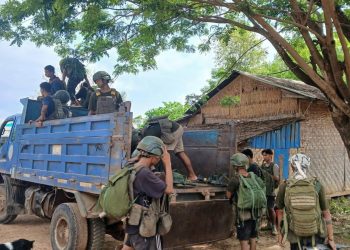
The standoff escalated on 14 February when three trucks carrying MNDAA reinforcements traveled from Lashio down to the town of Hsenwi. That evening, heavy fighting broke out.
“During the night clashes, they were firing at each other with 40mm heavy weapons and small arms,” a local resident reported. “People in the town are terrified that the fighting will intensify.”
The complex web of alliances in the region was further highlighted by a separate incident involving fighters from the People’s Defense Forces (PDF)—the armed wing of Myanmar’s exiled civilian government.
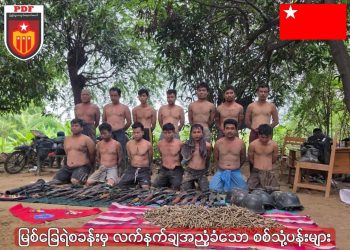
MNDAA forces intercepted a group of PDF fighters attempting to enter Kutkai. Upon finding TNLA uniforms in their possession, the MNDAA temporarily detained them. Sources confirm that once their identities as PDF members were verified, the MNDAA subjected them to physical punishment—forcing them to do squats—before releasing them.
The infighting threatens to undermine the momentum of the broader resistance against Myanmar’s military council. In an effort to de-escalate the crisis, ground sources indicate that top leaders from both the MNDAA and TNLA are arranging emergency talks in the border city of Laukkai.
“This kind of territorial tension between revolutionary groups risks damaging the momentum of the war against the military council,” a local resistance fighter in Kutkai warned. “We have received news that the two groups will negotiate. Fighting each other is completely unacceptable, so these talks need to happen quickly.”
Locals are urging the leadership of the Northern Brotherhood Alliance to quickly address the misunderstandings and the apparent lack of command control over lower-ranking troops before the violence spirals further.