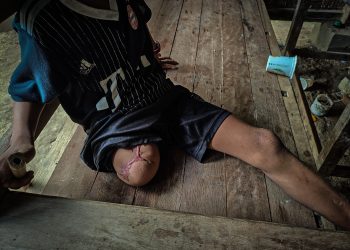

By Hlaing | MPA
Myanmar has become one of the most difficult places in the world to protect the right to education, the United Nations Children’s Fund (UNICEF) has warned.
In a statement released on 24 January, the agency highlighted the deteriorating situation for students across the country, where intensifying clashes between military forces and resistance groups are dismantling the school system.
Since the military coup, the education sector has faced a multi-front crisis. Teachers and parents report that safety concerns, a controversial curriculum, and economic instability are combining to drive a “lost generation” of learners.
Educators participating in the Civil Disobedience Movement (CDM) argue that the military administration’s education policies are failing students.
“The challenges are immense,” a CDM teacher told the Myanmar Pressphoto Agency (MPA). “The ‘all-pass’ system means children are moving up grades without actually learning. On top of that, they have raised the curriculum standards but stuck to a rote-learning ‘memorise and answer’ method.”
The teacher added that the gap between urban and rural students is widening: “Only children in the cities, whose parents can afford private tuition from a young age, are coping. The rest are being left behind.”
Beyond the curriculum, the physical act of going to school has become life-threatening. Reports of airstrikes targeting schools and religious buildings used as makeshift classrooms have terrified communities.
For those attempting to learn online, poor internet connectivity remains a major barrier.
“We are only trying because we want our children to be educated, but sending them to school feels unsafe,” said a parent from Magway Region. “The military danger is the primary fear, followed by financial hardship. Both parents and children are struggling on every front.”
In resistance strongholds like Sagaing and Magway, a parallel education system has emerged. Volunteer teachers run mobile schools to evade attacks, but they face severe shortages of textbooks and teaching aids.
“Education is the backbone of a country, but right now, many talented students feel their journey ends after Grade 12,” a volunteer teacher in Sagaing Region explained. “They cannot access universities. However, in some areas, vocational training is being provided for graduates, which is a small silver lining in a bad situation.”
According to Article 26 of the Universal Declaration of Human Rights, “everyone has the right to education.” Yet, in Myanmar, this right is being systematically violated.
The crisis is compounded by mass displacement. According to UNICEF data from August 2025, more than 3.5 million people have been forced to flee their homes due to conflict and insecurity—one-third of whom are children.