
By Mon Lay | MPA
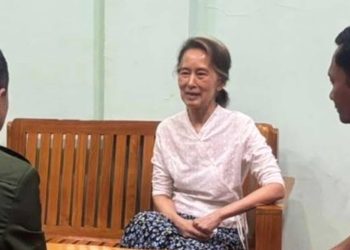
Myanmar’s military government has explicitly ruled out the release of ousted leader Aung San Suu Kyi, stating there are no plans to free her and insisting that her prosecution will proceed strictly “according to the law.”
In comments published by state-controlled media, junta spokesperson Major General Zaw Min Tun dismissed the political nature of the Nobel laureate’s detention.
He characterized the multiple charges against her—which range from corruption to incitement—as purely criminal matters.
“Daw Aung San Suu Kyi’s cases are not political; they are criminal matters involving corruption and bribery,” Maj Gen Zaw Min Tun said. “Therefore, the process will continue in accordance with the law.”
The statement marks a significant rejection of repeated appeals by the Association of Southeast Asian Nations (ASEAN) and the wider international community, who have consistently called for her release as a prerequisite for peace negotiations.
Political analysts say the military’s doubling down on these charges effectively ends hopes for a negotiated solution to the country’s bloody five-year conflict.
“The commission’s statement completely shuts the door on any dialogue that could resolve Myanmar’s political crisis,” one analyst told MPA.
Observers view the junta’s insistence on “legal procedure” as an attempt to legitimize the detention of the popular leader. However, activists argue that recasting political charges as criminal offenses is a calculated move to tarnish her reputation among the public.
“Keeping Daw Aung San Suu Kyi in custody without release is simply the military using her as a hostage for their own political bargaining,” said a prominent activist.
Critics point to the lack of transparency surrounding the legal proceedings as evidence of the junta’s intent. Since the military seized power, Aung San Suu Kyi’s trials have been conducted in secret, with the public and media barred from attending.
Analysts argue that this opacity proves the military’s claims are “far from the truth.”
Despite the spokesperson’s attempts to frame the 80-year-old leader as a criminal, observers believe public trust in her remains unshaken. Conversely, the refusal to release her is expected to fuel further public resentment and anti-regime sentiment.
The military’s hardline stance suggests a strategy to permanently exclude opposition figures from the political sphere to secure their own grip on power.
However, experts warn that this rigidity is likely to invite tighter economic and political sanctions from Western nations, further isolating the regime.