
By MPA
The United Nations will not recognize or legitimize the general election staged by Myanmar’s military junta earlier this year, characterizing the process as a naked institutional maneuver designed solely to entrench dynastic military rule, the UN Special Envoy has explicitly declared.
Addressing an informal session of the UN General Assembly in New York on 19 June, Ms. Julie Bishop, the Special Envoy of the Secretary-General on Myanmar, delivered her 10th official briefing, offering a scathing indictment of the military council’s recent political transitions and the catastrophic humanitarian freefall occurring on the ground.
Ms. Bishop highlighted that the January 2026 polls—which saw a predictable landslide victory for the military’s political proxy, the Union Solidarity and Development Party (USDP)—were designed to work in tandem with the 25% of parliamentary seats permanently reserved for active-duty soldiers under the military-drafted 2008 Constitution.
Furthermore, she dismissed Naypyidaw’s March reshuffle, which saw Senior General Min Aung Hlaing officially “retire” as Commander-in-Chief to be selected as a “civilian” political leader by a military-dominated legislative body.
“The vast majority of stakeholders and observers on the ground do not view this transition as a transfer of power to a civilian government,” Ms. Bishop stated. “It is universally understood as a consolidation of military hegemony.”
The ‘100-Day Plan’ Gambit
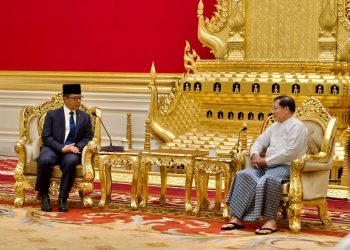
The Special Envoy revealed she has conducted four official diplomatic missions to Myanmar during her tenure, holding three face-to-face meetings with junta chief Min Aung Hlaing, with the most recent encounter taking place on 21 May.
During their latest meeting, Min Aung Hlaing reportedly pitched a “100-Day Plan” aimed at nominal economic recovery and “national reconciliation,” alongside an open invitation for armed resistance groups and Ethnic Armed Organizations (EAOs) to engage in peace talks.
However, Ms. Bishop told the General Assembly that she directly confronted the junta chief regarding the total lack of credibility surrounding his overtures, citing the military’s ongoing intensification of scorched-earth offensives and unprovoked airstrikes on civilian targets.
“One must ask how Naypyidaw expects to achieve diplomatic legitimacy through engagement while simultaneously maintaining a governance model defined by severe restrictions on fundamental freedoms and systemic human rights abuses,” Bishop remarked.
Breaking Grim Global Records
The UN brief illustrated that Myanmar is currently setting tragic historical precedents across multiple global metrics due to the prolonged conflict:
- Industrial Cybercrime: The country has evolved into a global epicenter for industrial-scale online scam compounds, with trafficking syndicates expanding their operations as far as Africa to ensnare victims from the Americas, Asia, and beyond.
- Narcotics and Landmines: Myanmar remains the primary global supplier of methamphetamine and opium, while simultaneously surpassing all other nations to become the world’s most heavily landmine-contaminated country, leading to unprecedented civilian casualties.
- Child Atrocities: The year 2026 has been recorded as the deadliest period for children since the 2021 coup, with military airstrikes identified as the primary driver of youth mortality.
- Humanitarian Catastrophe: Famine indicators place Myanmar among the top six most severe hunger hotspots globally. Internal displacement has swelled to over 3.7 million internally displaced persons (IDPs), with an additional 1.6 million seeking asylum across regional borders.
Demands for Suu Kyi’s Release
Coinciding with the 81st birthday of ousted State Counsellor Daw Aung San Suu Kyi on 19 June, Ms. Bishop renewed her urgent demand for the immediate, unconditional release of the Nobel Peace Prize laureate and all political prisoners.
While noting that former President U Win Myint had been moved from formal prison confinement, she criticized the severe, ongoing restrictions placed upon him as an obstacle to international goodwill. She emphasized the consensus among internal and external stakeholders that no tangible progress toward national reconciliation can manifest as long as Daw Aung San Suu Kyi remains arbitrarily detained.
Strategic Path for Resistance Forces
The Special Envoy also confirmed recent strategic consultations with the Leadership Council for the Establishment of a Federal Democratic Union (SCEF), an alliance aiming to unify the political and military objectives of the anti-junta resistance.
Political analysts monitoring the briefing noted that as the junta’s forced conscription law continues to drive thousands of youth into hazardous illegal migration pathways—rendering them highly vulnerable to human trafficking networks—the resistance must adapt. Analysts argue that revolutionary bodies must explicitly enshrine protection frameworks for vulnerable youth and ethnic minorities, including the Rohingya, directly into their federal policy frameworks, while systematically documenting war crimes to amplify international diplomatic pressure on the regime.