
10 June 2026 By Ko Myo
PAKOKKU, Myanmar — Central Myanmar’s Magway Region has been battered by 116 ground clashes and nearly 130 separate military air attacks over a 30-day period, inside a sweeping military offensive that has incinerated thousands of homes and triggered a severe displacement crisis.
A comprehensive conflict data report published by the Tamar Institute of Development reveals that active hostilities broke out across 10 separate townships in Magway throughout May.
Faced with structural setbacks on the ground, the military junta deployed a devastating array of aerial assets across five target townships, executing 104 conventional airstrikes, 13 commercial drone bombardments, and 12 tactical sorties using paramotors and gyrocopters—bringing the total number of documented airborne assaults to 129.
The combination of high-altitude bombing runs, unprovoked heavy artillery barrages, and ground-level arson sweeps by regular infantry columns has completely demolished more than 2,000 civilian homes and municipal structures across the dry zone.
The report estimates that approximately 66,500 civilians across seven townships have been forcibly displaced from their ancestral villages, scattering blindly into remote forests and monastic sanctuaries with zero access to clean water or sustainable shelter.
“Our forces achieved major historic milestones in May despite facing overwhelming aerial pressure,” a regional People’s Defence Force (PDF) information officer told MPA. “The liberation of Thayet Kan—a heavily fortified pro-junta Pyu Saw Htee militia village in Myaing Township—was a massive victory.
The junta is desperate to secure Magway because it serves as their absolute logistics gateway to reinforce collapsing fronts in Chin and Rakhine states.
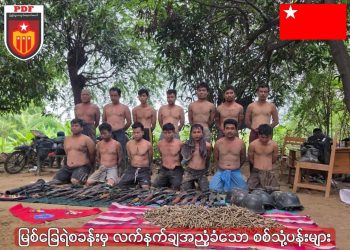
Despite their non-stop bombing runs, our joint units pushed forward and successfully captured another major militia enclave, Kokko Su village in Pauk Township, on 4 June.”
The military’s primary strategic objective centers on regaining absolute administrative control over five critical transit veins slicing through Magway: the Pathein–Monywa highway, the Salin–Kanbyar–Sidoktaya corridor, the Theekone–Saw–Kangyi–Kyaukhtu mountain pass, the Kyaukhtu–Tabayin–Pauk axis, and the Pakokku–Myitche trading road.
These pathways represent vital tactical supply lines linking central Myanmar to the volatile western frontiers of the country.
In a bid to isolate resistance cells operating along these asphalt corridors, junta battalions have established tight check-points, instituted a total blockade on commercial shipping, and unleashed indiscriminate scorched-earth operations against roadside communities.
The Tamar Institute of Development warned that the regime’s economic siege has trapped over 65,000 internally displaced persons (IDPs) in an artificial humanitarian bottleneck.
With the flow of consumer goods, emergency medicine, and basic rice shipments entirely frozen by military decree, grassroots aid monitors warn that the regional nutritional deficit is spiraling into a catastrophic, man-made famine.