
11 May 2026 By Nway
KALAY, Myanmar — Displaced residents attempting to return to the town of Falam in Chin State are facing a crippling financial barrier as Myanmar military forces impose “road fees” reaching into the thousands of dollars at newly established checkpoints.
Following the military’s reoccupation of Falam on 25 April, junta troops have seized control of the vital Kalay-Falam highway. Since then, at least five major checkpoints have been established, turning a routine journey into a high-stakes extortion scheme.
According to a displaced resident currently in Kalay, the tolls are staggering. Large trucks are being forced to pay between 8 million and 10 million Kyats (approximately $3,800 to $4,700) to pass through the military corridor. Smaller vehicles are not exempt, with drivers being charged between 3 million and 5 million Kyats ($1,400 to $2,300).
“The military is broadcasting that people can now return to the town safely, but with fees like this, no one can afford to move,” the resident told MPA. “When we fled, the total cost was only 3 million Kyats for the entire trip, mostly paid to the drivers. The resistance checkpoints only took small voluntary donations—maybe $10 or $20.”
Military sources in Falam confirmed that the extortion is concentrated at five key points: Taung Phila, the 8-mile and 9-mile marks, the Khaikam Police Station, and the Khaikam Toll Gate.
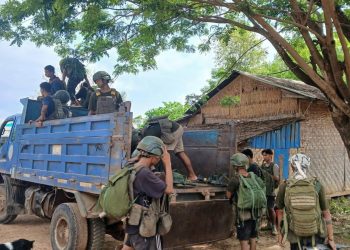
While the junta is eager to project an image of normalcy—even transporting over 100 non-CDM civil servants from Kalay to Falam on 7 May to restart the local administration—the town remains largely deserted. Locals say the combination of exorbitant travel costs and the pervasive fear of the military is keeping thousands of people in hiding or in temporary camps.
Analysts suggest the high tolls serve a dual purpose: generating immediate revenue for cash-strapped units and controlling the flow of people and goods into a strategic region. By pricing out the average civilian, the military maintains a “ghost town” environment that is easier to monitor and defend against resistance activity.
As the junta prepares to reinstall its administrative machinery in Chin State, the people of Falam find themselves caught in a predatory trap—invited back by official proclamations, but blocked by the very forces that claim to offer them security.