
22 April 2026 By Ko Myo
WASHINGTON D.C. / BRUSSELS — The United States and the European Union have welcomed the recent release of several political prisoners in Myanmar but warned that the gesture must be followed by the unconditional freedom of all those remaining in detention, including Daw Aung San Suu Kyi.
In a statement released on Wednesday, the US Embassy in Yangon expressed support for the release of figures such as Win Myint and the prominent documentary filmmaker Shin Daewe, who were freed during the traditional New Year amnesty on April 17. Washington reaffirmed its commitment to supporting a path toward peace and stability in the conflict-torn nation.
The diplomatic language used by Western powers has, however, sparked debate among local activists. Some noted that official statements from both the US and the EU referred to the ousted leader simply as “Win Myint,” omitting his title as the democratically elected President.
“They used the name Win Myint, seemingly following the junta’s lead by dropping the presidential title,” a Monywa-based political activist told MPA. “Even in supportive statements, the lack of formal recognition is a concern for those of us fighting for the 2020 election mandate.”
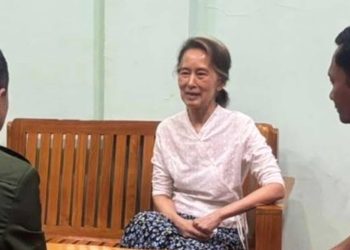
While President Win Myint has returned to his family, the whereabouts of State Counsellor Aung San Suu Kyi remain unknown. The 80-year-old leader has been held in isolation since the 2021 coup, and her continued disappearance has triggered widespread alarm.
The human rights group “All in One Piece Movement” has launched a “Proof of Life” campaign, demanding the military junta provide evidence that the Nobel Laureate is alive and in good health. Her youngest son, Kim Aris (also known as Htein Linn), has repeatedly voiced his profound anxiety over his mother’s condition.
The European Union’s spokesperson for Foreign Affairs and Security Policy, Anitta Hipper, also welcomed the commutation of death sentences to life imprisonment but urged the junta to end all arbitrary detentions.
Despite the military’s announcement that 4,335 inmates would be freed, data from the Political Prisoners Network Myanmar (PPNM) reveals a far more modest reality. As of April 18, only 1,686 individuals had actually been released across 40 prisons, with political prisoners accounting for just 292 of that number.
As international pressure continues to build, the focus remains on whether these limited releases are a genuine shift in policy or a strategic move by Senior General Min Aung Hlaing to deflect criticism as he attempts to entrench his self-appointed administration. For the families of the thousands who remain behind bars, the struggle for a “better tomorrow” remains far from over.