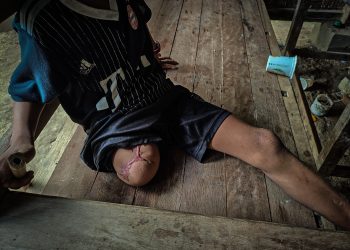

YANGON, Myanmar — Activist groups and military defectors have warned that Senior General Min Aung Hlaing’s formal ascension to the presidency will lead to an even higher death toll among frontline soldiers, as the military doubles down on its violent campaign to secure the junta chief’s political ambitions.
The advocacy group People’s Goal, which supports military defectors, stated that by installing himself as President within a military-controlled national assembly, Min Aung Hlaing is attempting to formalize a “reign of terror” through institutional means.
A former officer who joined the Civil Disobedience Movement (CDM) and is currently based near the border, told MPA that the title change does little to alter the General’s legal standing. “He moved from Acting President to President in a blatant power grab. He has intended to be President for life since the coup, so this is not a surprise,” the officer said. “Being President won’t erase his war crimes or his status as a fugitive. It also won’t stop the violence; it will only force lower-ranking soldiers to sacrifice their lives to protect his seat.”
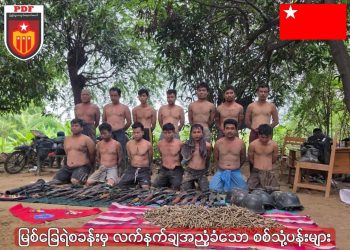
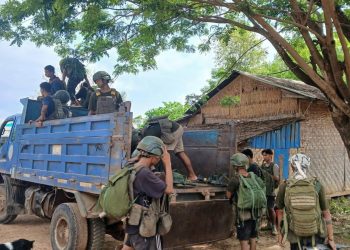
The transition comes amidst a steady trickle of desertions from the military’s ranks. According to figures from People’s Goal, 36 military personnel either defected or were captured in March 2026. Among them, 19 voluntarily sought asylum with the resistance, the majority of whom were new recruits drafted under the national conscription law.
While the number of defectors remains significant, analysts note a decrease compared to February, when 199 military personnel were either captured or defected. Of those, 45 surrendered voluntarily. The decrease in March is attributed by some to the military’s tightened grip on its units as it prepares for a major dry-season offensive.
“Most of those coming over now are conscripts,” a spokesperson from People’s Goal added. “But even as he [Min Aung Hlaing] celebrates his new title in the capital, the reality on the ground is that his troops are facing a morale crisis.”
The National Unity Government (NUG) and other resistance forces have dismissed the presidential appointment as a “sham.” They argue that the military’s move to integrate its leadership into a civilian-style structure is a desperate attempt to gain international legitimacy that remains elusive.
As the conflict shows no sign of abating, the rank-and-file soldiers—many of whom are now forced into service through mandatory conscription—remain the primary casualties of a war fought to maintain the Senior General’s grip on power. For those on the frontlines, the news of a new President in Naypyidaw offers little hope for peace, signaling instead a continuation of the grinding attrition that has defined Myanmar since the 2021 coup.