
Supporters of Myanmar’s military junta have sparked controversy by claiming that a recent deadly airstrike on a civilian area near the Chinese border was carried out with the tacit approval of Beijing.
The strike, which occurred at midnight on 22 February, targeted Bum Ka Htaung village in the Mai Ja Yang region—a territory under the control of the Kachin Independence Army (KIA). Local sources confirmed that a 75-year-old man was killed when bombs hit residential homes.
In the aftermath of the attack, pro-military accounts on social media began circulating claims that the junta had received a “pass” or “green light” from China to conduct the operation. These narratives suggest that Beijing is increasingly frustrated with the KIA’s recent territorial gains and “urban capture” operations.
However, political analysts have dismissed these claims as a psychological warfare tactic. “These narratives are designed to drive a wedge between revolutionary forces and neighboring China,” one analyst told the Myanmar Pressphoto Agency (MPA). “In reality, it is highly unlikely that China welcomes the sound of bombs falling so close to its own sovereign border.”
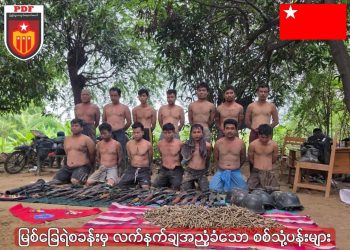
Military observers suggest the strike was a retaliatory move following significant junta losses on the ground. On 21 February, the KIA reportedly seized a key outpost belonging to Light Infantry Battalion 236 near Bhamo, inflicting heavy casualties on junta troops.
The KIA has reported a surge in indiscriminate air attacks across multiple brigades, including areas with no active frontline fighting. A spokesperson for the group stated that the military is increasingly targeting non-military sites as they lose their grip on territory in Kachin State.
Human rights activists have condemned the midnight raid as a clear war crime. “Killing an elderly man in his sleep cannot be justified by any military objective,” one activist said. “Regardless of the propaganda being spun, this is a deliberate act of terror against a civilian population.”
As the KIA ramps up its offensive to capture Bhamo, the regional security situation remains precarious. The junta’s reliance on air power continues to drive up civilian displacement and casualties, while the diplomatic fallout regarding China’s alleged role remains a point of intense scrutiny.